Brutalism—named after béton brut, or raw concrete—emerged in the 1950s from the modernist movement, championed by Le Corbusier and later defined by British architects Alison and Peter Smithson. Its bold forms and exposed materials became the face of post-war reconstruction, shaping housing estates, universities, civic centres, and car parks with an ethos of social ambition. Though once hailed as a utopian vision of urban living, by the 1970s the style faced criticism for its perceived coldness and association with urban decline, leading to widespread demolition and decades of disdain.
I’ve been running Brutalist Architecture Tours in London for the past seven years, and one thing I always stress is this: we shouldn’t romanticise the style without acknowledging the lived experience it often entails—an experience that isn’t always comfortable. We often admire them in books for their monumentality and sombre elegance, but to truly understand them, you have to walk through them. There’s something in their smells, the reverberation of voices in empty corridors, the odd angles and strange silences that brings their story to life. With thoughts of one day launching tours in Paris, I’ve pulled together a list of sites I find utterly captivating—each one offering its own brutal kind of beauty.
What can we learn from Brutalism’s fall from grace—and its slow, defiant return?
Don’t miss 23 Spots You Shouldn’t Miss in Paris If You Love Architecture
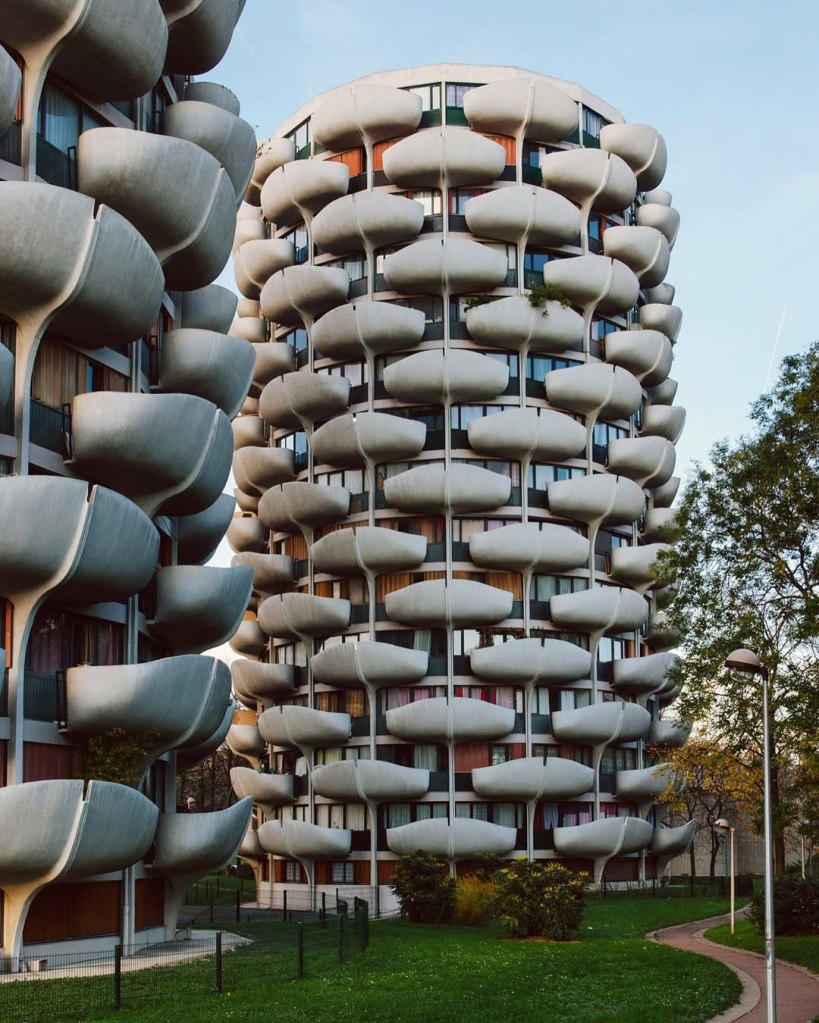
1. Les Choux de Créteil
Architect: Gérard Grandval
Location: 2 Bd Pablo Picasso, 94000 Créteil, France (Google)
Year: 1974
Description: Les Choux de Créteil, designed by Gérard Grandval in the 1970s, stand as an emblematic example of French Brutalism in suburban housing. Characterised by béton brut construction and prefabricated modular elements, the towers reflect a sculptural approach to high-density living. The distinctive flared balconies serve both bioclimatic and aesthetic functions, offering solar protection and visual rhythm. The nickname ‘cauliflowers’ wasn’t ironic—they were literally designed to let residents grow salad on their balconies. Today, the complex remains a bold testament to the era’s utopian social ambitions and experimental urban morphology. Read more here.

2. Maison du Brésil
Architect: Le Corbusier & Lúcio Costa
Location: 7 L Bd Jourdan, 75014 Paris, France (Google)
Year: 1959
Description: Lúcio Costa and Oscar Niemeyer, key figures in Brazilian modernism, invited Le Corbusier in 1936 to consult on the Ministry of Education and Health Building in Rio de Janeiro. He spent three weeks in Brazil, producing influential sketches—marking his first substantive collaboration with Costa. In 1952, as planning began for Maison du Brésil at the Cité Internationale Universitaire, Costa again invited Le Corbusier to co-design the residence. The building’s modular structure follows the Modulor system, while the interiors reflect Costa’s preference for warm colours and natural materials. Horizontal brise-soleils regulate light and articulate the façade’s rational composition. With its béton brut surfaces and pilotis-supported form, the building embodies Corbusier’s late Brutalist language and stands today as a lasting expression of mid-century utopian ideals. Read more here.

3. Tour Totem
Architect: Pierre Parat and Michel Andrault
Location: 59 Quai de Grenelle A, 75015 Paris, France (Google)
Year: 1979
Description: Tour Totem, completed in 1979 as part of the Front de Seine development, exemplifies the structural clarity and monumental scale of late Brutalism. Planned as a mixed-use high-rise, it reflects the era’s interest in megastructural urbanism and dense vertical programming. Its exposed concrete service spine and repetitive modular façade panels express a commitment to functional legibility and material honesty. A little-known detail: beneath its heavy exterior lies a high-speed lift system once promoted as a ‘vertical motorway’. Read more here.

4. Les Orgues de Flandre
Architect: Martin van Trek
Location: 69-95 Av. de Flandre, 75019 Paris, France (Google)
Year: 1974
Description: Comprising nearly 2,000 homes, Les Orgues de Flandre rise like high-density concrete pipe organs in Paris’s 19th arrondissement. Their béton brut surfaces, massive volumes, and expressive vertical segmentation define them as purebred Brutalist housing. Each tower varies in height and profile, breaking up the mass with sculptural articulation and a rhythm almost musical. Circulation cores are externalised, celebrating infrastructural honesty in full view of the city. Locals nicknamed them les tuyaux d’orgue—not just for form, but for the eerie acoustic echoes in the courtyards. If you go, pay attention to this. Read more here.

5. Centre National de la Danse
Architect: Jacques Kalisz
Location: 1 Rue Victor Hugo, 93500 Pantin, France (Google)
Year: 1972
Description: Originally an administrative block from the 1970s, the Centre National de la Danse looms like a concrete fortress. Jacques Kalisz, who trained as an engineer before becoming an architect, was known for giving state institutions a physical presence as imposing—and sculptural—as any cathedral, and pioneered what later became known as ‘administrative monumentalism’. Its béton brut façade, cantilevered massing, and monolithic scale are quintessentially Brutalist. The building’s rhythmic fenestration and abrupt volumetric shifts have been featured in movies like ’99 Francs’ and ‘Bondy’. Inside, raw concrete meets soft lighting and open rehearsal spaces. When converted into a dance centre in 2004, some argued the building finally learned to move. Read more here.
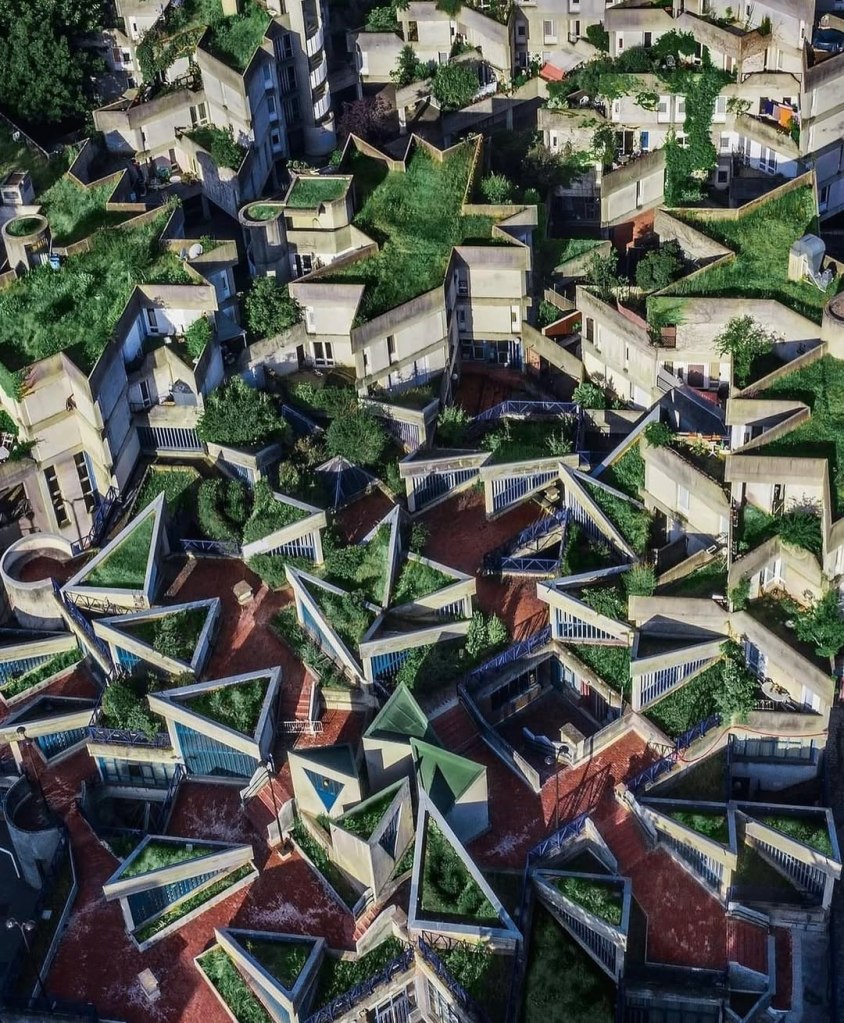
6. Ivry-sur-Seine Social Housing Project
Architect: Jean Renaudie and Renée Gailhoustet
Location: 9 All. du Parc, 94200 Ivry-sur-Seine, France (Google)
Year: 1975
Description: The Ivry-sur-Seine Social Housing Project, designed by Jean Renaudie and Renée Gailhoustet in the 1970s, represents a unique and humanist interpretation of Brutalism: Its use of fragmented volumetrics and exposed structural articulation exemplifies a departure from rigid modernist orthodoxy. Rather than uniform blocks, the complex unfolds as an interlocking system of angular terraces and varied levels, integrating housing with public space. Each unit features outdoor access and planters, blurring the boundary between architecture and landscape. Notably, Renaudie himself resided in the complex, embedding his architectural ideology in lived form. The project remains a rare example of socially engaged Brutalism that prioritises spatial complexity and individual agency. Read more here.

[BONUS] Student Residence
Architect: Bruther and Baukunst
Location: Boulevard Gaspard Monge, 91120 Palaiseau, Île-de-France France (Google)
Year: 2020
Description: Though technically neo-Brutalist, this sculptural hybrid deserves more than a polite nod—it’s a concrete wonderbox. Programmatically, it combines 185 student housing units with a 500-space car park, commercial areas, and communal facilities, all layered vertically to maximize spatial efficiency. The genius lies in its reversibility: parking decks can one day become housing or offices, making it a blueprint for future-proof urban design. And why visit? The helical circulation ramps, which by the way are public. It’s Brutalism reimagined: leaner, lighter, but no less bold. Read more here.
Check these and other amazing buildings of Paris on the map below or download The Free Architecture Guide of Paris.

 Virginia Duran
Pingback: Top 23 Spots You Shouldn’t Miss in Ljubljana If You Love Architecture | Virginia Duran
Pingback: 23 Spots You Shouldn’t Miss in Munich If You Love Architecture | Virginia Duran
The architectural heritage is, without a doubt, infinite. So often ahead of its time, only time itself and lived experiences will give meaning to each style and form, no matter what era it is from or returns to. Your paragraph about smells, voids, angles and silences, for example, demonstrate how much lived experience is as relevant as the beauty or strangeness of buildings. Beautiful post.
LikeLike
Thanks for your kind words! Indeed, buildings on paper are very different than buildings in real life. And another topic you mention is the way time passes for these locations, always a reflection of who we are as a society and what we value.
LikeLike
Thank you Virginia. There’s always so much to learn from your messages!Best regards,Carmen Medina
LikeLike
Thank you Carmen! Any favourites on the list?
LikeLike
Hi Virginia. I’m not a fan of Brutalism
LikeLike
hahaha respect! Any buildings in the list you might like?
LikeLike
Wow! Great post! This style of architecture is fascinating in a creepy kind of way (IMO).
LikeLike
That’s great to hear, I am a big fan too 🙂 Any favourites on the list?
LikeLike
Probably the leCorbusier, but I think the last one, the housing project, is pretty cool.
LikeLike
Yeah, the last one is very very special. I am hoping to visit soon 🙂
Have a lovely Sunday.
LikeLike
Hi, Virginia– I’ve enjoyed following you over the years! I’m not a geek when it comes to architecture, but…..I have visited Fallingwater and Kentucky Knob ( nearby Fallingwater) and kind of know, at 73 years of age, what I like and why. 40 years ago I had this repeating dream of a very unusual house. One day I visited the local library ( before computers, etc) and saw a book that had a photo of FLW’s Fallingwater house on the cover or inside. I almost yelled out in the library, as I finally found the house from my literal dreams. I have no idea how my sleeping and tapped into this house in such detail- I knew stuff that was validated when I visited the house. Being able to actually walk through the house, decades later, was an amazing experience! If I were to design my own home, I think I would go with a Craftsman style home. I just love all of the woodwork, details and built-ins. At my age and health ( fighting cancer the past 18 months) it’s not likely there is a Craftsman home in my future, but maybe next time around.
Keep posting. I love what you bring to the rest of us whose traveling days are limited.
LikeLike